
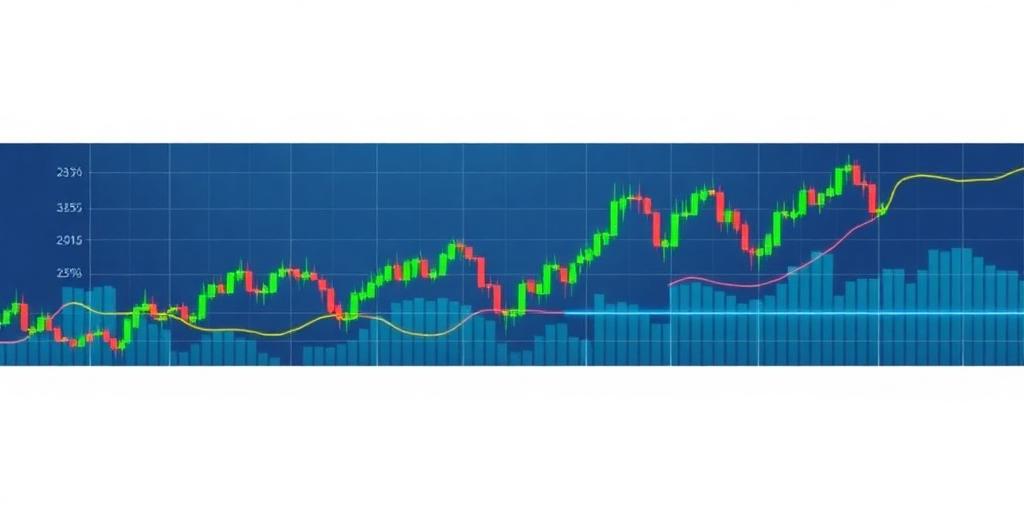
Moving Averages: A Simple Yet Powerful Analysis Tool
Moving averages are a fundamental tool in technical analysis, used by traders and investors to smooth out price data and identify trends. They provide a clear view of underlying price movements, helping to make informed decisions. This post will explain what moving averages are, how they're calculated, and how they can be used in trading and investment strategies.
What is a Moving Average?
A moving average (MA) is a calculation that averages out a stock's price over a specific period. It's called "moving" because as new price data becomes available, the average is recalculated, shifting along the price chart. This helps to filter out short-term noise and highlight the direction the price is trending.
Types of Moving Averages
There are several types of moving averages, each with its own formula and sensitivity to price changes:
- Simple Moving Average (SMA): The SMA is the most basic type. It calculates the average price over a specific period by adding up the prices and dividing by the number of periods.
- Exponential Moving Average (EMA): The EMA gives more weight to recent prices, making it more responsive to new information. This can be useful for identifying trends quickly.
- Weighted Moving Average (WMA): Similar to the EMA, the WMA assigns different weights to prices within the period, but it does so linearly. The most recent price has the highest weight, and the weight decreases linearly for older prices.
How to Calculate a Simple Moving Average (SMA)
The formula for calculating a Simple Moving Average is:
SMA = (Sum of prices for the period) / (Number of periods)
For example, to calculate a 10-day SMA, you would add up the closing prices for the last 10 days and divide by 10.
How to Use Moving Averages
- Identifying Trends: Moving averages help identify whether a price is trending up, down, or sideways. A rising MA indicates an uptrend, while a falling MA suggests a downtrend.
- Support and Resistance: Moving averages can act as dynamic support and resistance levels. Prices often find support at a rising MA or meet resistance at a falling MA.
- Crossovers: Crossovers between different moving averages can generate buy or sell signals. For example, when a short-term MA crosses above a long-term MA, it's a bullish signal (a "golden cross"). Conversely, when a short-term MA crosses below a long-term MA, it's a bearish signal (a "death cross").
- Confirmation: Traders often use moving averages to confirm other signals. For example, if a stock breaks out of a chart pattern, a moving average can help confirm the breakout.
Advantages of Using Moving Averages
- Simplicity: Moving averages are easy to understand and calculate.
- Versatility: They can be applied to any market and any timeframe.
- Trend Identification: Moving averages are effective at identifying trends.
Limitations of Using Moving Averages
- Lagging Indicator: Moving averages are lagging indicators, meaning they react to past prices. This can result in delayed signals.
- Whipsaws: In choppy markets, moving averages can generate false signals, known as whipsaws.
- Parameter Sensitivity: The effectiveness of a moving average depends on the period used. Selecting the wrong period can lead to poor results.
Conclusion
Moving averages are a valuable tool in technical analysis, providing insights into price trends and potential support and resistance levels. While they have limitations, understanding how to use moving averages can improve your trading and investment strategies. By combining them with other indicators and analysis techniques, you can enhance your decision-making process and navigate the markets with greater confidence.


